
We’ve all experienced it. You click through to a website and, before you’ve even had a chance to look at a product, a pop-up takes over the screen offering you 10% off in exchange for your email address.
It’s become such a normal part of ecommerce that we barely question it. And the logic makes sense: email is an incredibly valuable channel, and building your own audience means more opportunities to bring people back and turn them into customers.
But did you know that showing your newsletter pop-up immediately could actually result in fewer sign-ups than waiting a few seconds?
And there’s a bigger CRO question here too: what is that pop-up doing to the people who came to your website to shop?
1.24 billion pop-ups tell an interesting story
Omnisend analysed 1.24 billion pop-up displays during 2025, resulting in 26.4 million email sign-ups. When they looked at the timing, this is what they found:
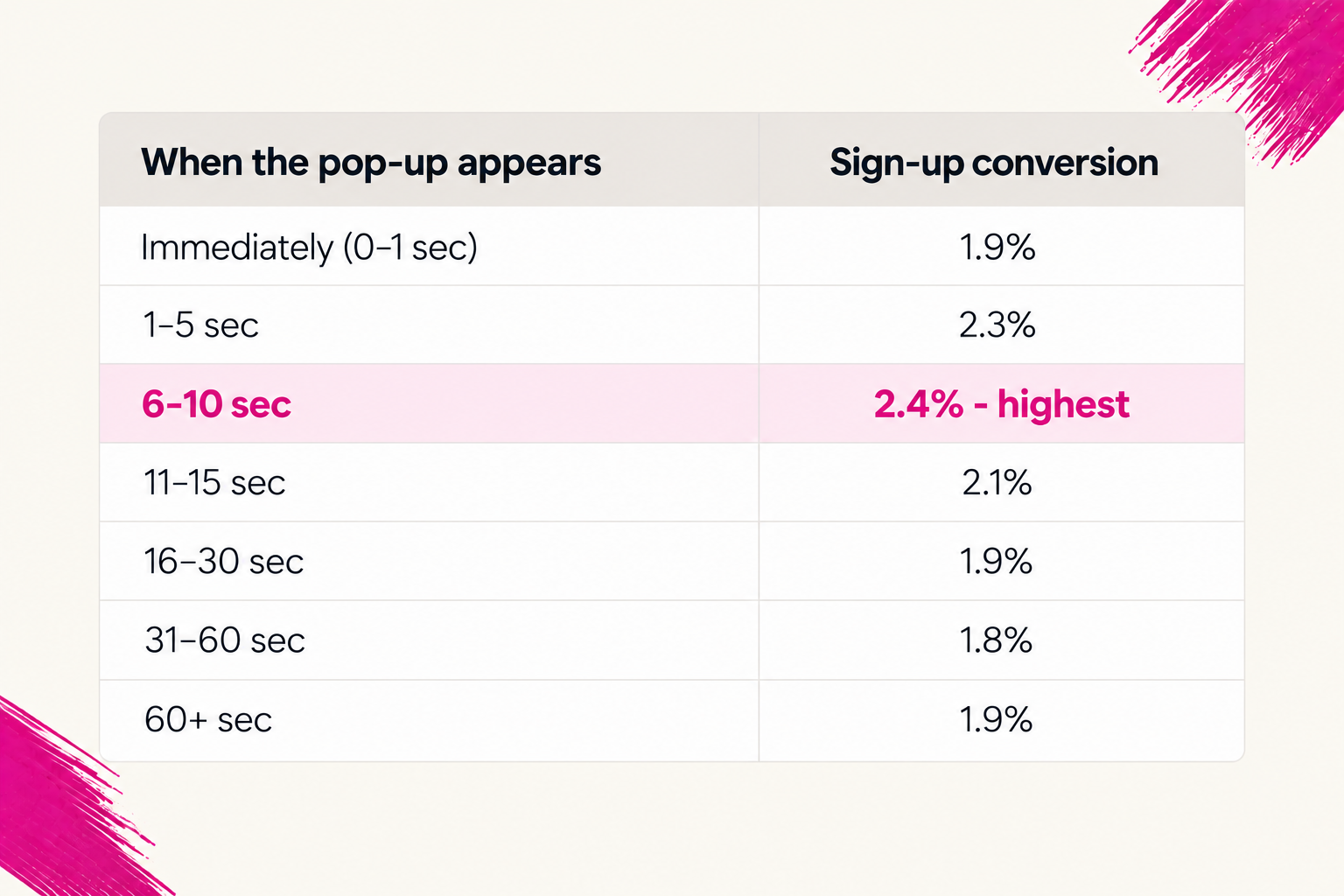
Simply allowing someone 6–10 seconds to understand the site before interrupting them increased sign-up conversion by around 26% compared with an instant pop-up.
When you think about it from the customer's perspective, it makes sense.
Someone lands on your site because they’ve clicked an ad, Google result, Instagram post or email. In those first few seconds they’re effectively asking:
Am I in the right place? Do I like the products? What's the price point? Do I trust this brand?
And before you’ve answered any of those questions, your website says: Give us your email address.
Sign-up rate isn't the same as website conversion rate
This is the bit we think often gets missed.
You open Klaviyo, see your pop-up has a 5% conversion rate and think: Brilliant, it’s working. But what happened to the other 95%?
Research from Made With Intent found more than half of shoppers dislike pop-ups appearing early in their visit, while around 1 in 5 said an email-capture pop-up appearing too soon could cause them to leave the site altogether.
Wisepops has also published A/B-test data covering more than 1.8 million ecommerce sessions. Its tests found delayed or behaviour-triggered pop-ups could reduce bounce among interacting visitors by as much as 45%, while changes to timing produced median conversion uplifts of 39–52% across the experiments analysed.
We’d treat those exact percentages cautiously.
Wisepops is a pop-up provider and these are aggregated tests across different stores but the direction is consistent with the much larger Omnisend dataset.
The headline……Give people a chance to shop before interrupting them.
Then there’s the 10% discount
Imagine I’m already ready to buy a £100 product and I arrive on your website and immediately get:
GET 10% OFF YOUR FIRST ORDER
Great for me. But you've potentially just given away £10 that you didn't need to.
Of course, discounts work. Omnisend found discount pop-ups converted at around 2.4% compared with 1.7% without a discount which is roughly a 41% relative increase in email capture.
But more email addresses don't automatically mean more profit.
The question isn't simply "Did 10% off increase our sign-ups?"
It's "Did the additional customers and future email revenue justify the margin we gave away?"
And that's why we'd recommend you should be looking at:
Website conversion rate
AOV
Revenue per visitor and
Gross margin alongside email capture.
So what should you test?
There isn't one perfect pop-up timing for every Shopify store, but Omnisend's data makes 6–10 seconds a sensible starting point.
If it was us…..we’d also test behaviour-based triggers.
Perhaps someone sees the offer after scrolling 25–30% of the page, viewing a second page or showing exit intent rather than simply because they've been on the website for two seconds.
And make it smarter. Don't repeatedly show the form after someone closes it.
Don't ask existing Klaviyo subscribers to join your newsletter.
Think carefully about offering a discount to someone who has already added products to their basket, and be particularly conservative on mobile where a pop-up can cover virtually the entire screen.
Klaviyo themselves recommends A/B testing sign-up form timing and triggers rather than assuming one approach works for everyone.
Most importantly, don't choose the winner based purely on email capture.
An instant pop-up might capture 5% of visitors with a 2.7% website conversion rate, while a delayed version captures 3.8% with a 3.0% website conversion rate.
The first looks better in Klaviyo. The second could be considerably more valuable to the business.
One to think about before Peak
There’s a timely reason to look at this now. As we head towards the busiest trading months, brands are understandably focusing on growing their email and SMS databases.
Absolutely do that….. but make sure the way you're building your list isn't getting in the way of people who are already trying to buy.
If your newsletter pop-up currently appears the second someone lands on your Shopify store, don't necessarily switch it off. Test the timing.
Because the most important question isn't "How many email addresses did our pop-up collect?"
It's "What did our pop-up do to the people who came here to shop?"
And if you want another pair of eyes on it, we’re always happy to have a look.